



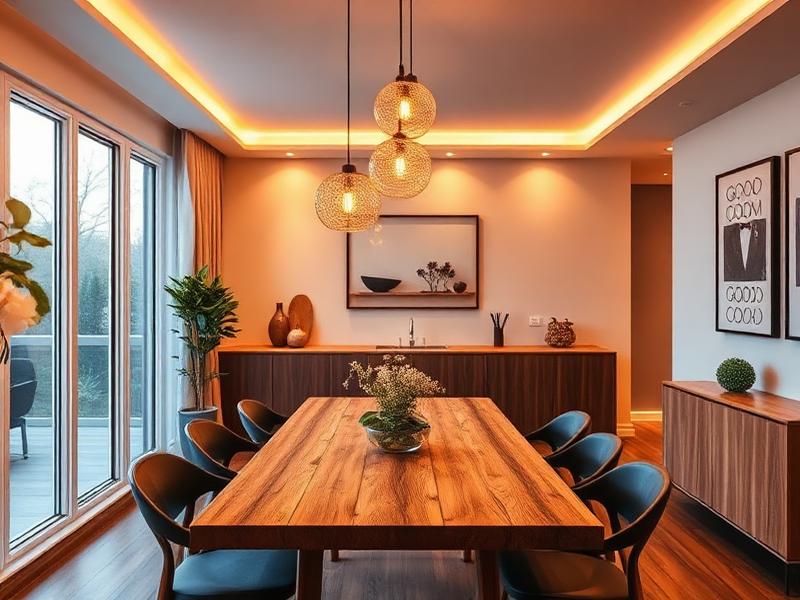


Choosing LED lighting for a home or business starts with the activity in each area, not with a single preferred wattage or colour. A kitchen worktop, living room, office desk, retail display, warehouse aisle and external entrance all place different demands on light output, distribution, glare control and protection. This guide turns those requirements into a practical specification.
1
Start with the task
Identify what people need to see, how accurately and for how long.
2
Plan useful light
Use lumens, beam angle, spacing and surface finishes to shape the result.
3
Choose the appearance
Coordinate colour temperature and colour rendering with the space and materials.
4
Check the environment
Confirm fitting, electrical, control and ingress requirements before ordering.
Match lighting to the activity
Good lighting helps people move safely, work accurately and use a space comfortably. The UK's Health and Safety Executive notes that more detailed work generally needs more light. Its examples range from 50 lux for a corridor or walkway to 300 lux for a process control room and 750 lux for studying an engineering drawing. These figures illustrate the task-based principle; a project should use the relevant current standard and a competent lighting design where required.
At home, the same principle applies without turning every room into an office. General lighting helps people move around, task lighting supports reading or food preparation, and accent lighting adds depth. Combining layers often produces a more useful result than relying on one very bright central fitting.
| Area | Primary need | Useful lighting approach | Questions to answer |
|---|---|---|---|
| Living room | Flexible general and relaxed lighting | Layer ceiling, wall, floor or concealed sources | Which activities need task light, and should any layer dim? |
| Kitchen | Clear preparation light plus general illumination | Put task light onto worktops and avoid body shadows | Is the fitting suitable for its location and easy to clean? |
| Bedroom | Comfortable general light and local reading light | Use separate controls for general and bedside functions | Will glare be visible when lying down? |
| Office | Task visibility with controlled glare | Combine even ambient light with local adjustment where useful | What screen, paper and detailed tasks are carried out? |
| Retail | Product visibility, circulation and visual emphasis | Balance general light with focused display lighting | Does the light render merchandise colours appropriately? |
| Warehouse or service area | Safe movement and task visibility | Use a planned grid suited to mounting height and aisle layout | Are shadows, obstructions and maintenance access addressed? |
Lumens, watts and beam angle
Lumens describe the light emitted by a product. Watts describe electrical input. When replacing an older lamp, compare lumens rather than searching only for the same wattage. The useful result also depends on beam angle and fitting position: a narrow beam concentrates light, while a wider distribution covers more area but may deliver less intensity at a specific point.
Room size alone is not enough to choose a lumen total. Ceiling height, surface reflectance, furniture, shelving, partitions and daylight all affect the layout. Dark finishes absorb more light, and tall objects can cast shadows. For important workspaces, calculate or measure illuminance on the actual task plane.
Colour temperature and colour rendering
Colour temperature is expressed in Kelvin and describes whether white light appears warmer or cooler. Colour rendering describes how faithfully colours appear under the source. Both matter: a suitable colour temperature can support the intended atmosphere, while stronger colour rendering can be important for food, clothing, artwork and product displays.
| Specification | What it tells you | Use it when comparing |
|---|---|---|
| Lumens | Total visible light output | Products intended to provide a similar amount of light |
| Watts | Electrical input power | Running cost after the required output is established |
| Lumens per watt | Efficacy | How efficiently products convert input power into stated light output |
| Kelvin | Appearance of white light from warmer to cooler | Atmosphere and consistency with other fittings |
| CRI or Ra | A general colour-rendering index | How important accurate colour appearance is to the task |
| Beam angle | Width of the emitted beam | Spacing, accent effects and the risk of bright or dark patches |
| IP rating | Tested resistance to solid and water ingress | Suitability for the stated environment and installation zone |
Choose the fitting type after defining the job
Once the lighting requirement is clear, select a fitting format that can deliver it. BrittLite's indoor LED lights cover multiple interior applications, while LED strip lights can add concealed, linear or under-cabinet lighting when paired with the correct system components.
For workplaces, shops and larger interiors, start with the commercial lighting collection. Ceiling grids may suit panel formats, while other projects may need surface, suspended or feature lighting. Product type should follow the ceiling construction, mounting height, maintenance plan and visual task.
Home lighting: plan in layers
- Use general lighting for safe movement and overall visibility.
- Add task lighting where reading, cooking, grooming or detailed work takes place.
- Use accent or concealed lighting to reveal shelves, textures or architectural details.
- Place controls where they match how people enter and use the room.
- Confirm dimmer, lamp and driver compatibility before expecting smooth dimming.
- Keep drivers, connectors and replaceable parts accessible for maintenance.
Connected control can be useful where it solves a real need. Timers, scenes or voice control should not replace basic electrical compatibility. When wall-based Wi-Fi and touch operation are appropriate, compare BrittLite's smart light switches and confirm gang count, one-way switching, wiring and network requirements.
Business lighting: design for tasks and maintenance
Business lighting often runs for longer hours and covers larger areas, so layout, glare, controls and maintenance deserve early attention. A product with good efficacy can still perform poorly if the spacing creates dark zones or if reflections affect screens and glossy surfaces. Trial areas and measured results are valuable before a large installation.
Consider who will replace or service the fittings, whether access equipment is needed, and how a failure affects operations. Zoning, scheduling and occupancy control may reduce unnecessary use, but every control must be compatible with the driver and intended switching arrangement.
Indoor, outdoor and damp locations
An indoor fitting should not be used outside simply because it sits under a canopy. Rain, condensation, dust, temperature, cable entry and physical exposure all affect suitability. Choose products with documented ratings for the intended location and make sure the complete installation, including joints and enclosures, maintains the required protection.
For entrances, walls and external circulation areas, review the dedicated outdoor LED lighting category. Aim and position external light carefully to support visibility without creating avoidable glare or spill.
Seven questions to answer before buying
1
What is the task?
Describe what people need to see and whether the space has more than one use.
2
How much light?
Set an output and distribution target based on dimensions, finishes and mounting height.
3
What appearance?
Choose a suitable white tone, colour rendering and visual style.
4
Where is it fitted?
Confirm ceiling, wall, cabinet, profile or outdoor installation requirements.
- Does the fitting size and mounting method suit the available structure?
- Are the voltage, driver, dimmer, sensor and switch arrangements compatible?
- Can the product be installed and maintained without concealing inaccessible components?
For larger projects: Record room dimensions, ceiling height, task areas, desired controls and existing wiring before requesting advice. Clear project information leads to a more useful product shortlist.
LED lighting selection FAQs
How many lumens do I need for a room?
There is no reliable room-only answer. Required light depends on the task, dimensions, mounting height, beam distribution, surfaces, daylight and layout. Use a lighting calculation for larger or task-critical spaces.
Is warm white or cool white better?
Neither is universally better. Choose the appearance that suits the activity and interior, and keep nearby fittings reasonably consistent unless contrast is intentional.
Does a high IP rating make a fitting suitable everywhere?
No. IP addresses tested ingress protection, not every environmental or installation risk. Temperature, corrosion, impact, cable entry, mounting and local requirements still matter.
Can I dim any LED light?
No. The lamp or driver must support dimming and be compatible with the chosen control. Check the stated method and load range.
Should home and business lighting use different products?
The selection should follow the task, operating hours, environment, controls and maintenance needs. Commercial projects often need more formal design and documentation, but the same core checks apply.
External reference: For official task-based workplace guidance, read the UK Health and Safety Executive's lighting and human factors guidance.